Showing posts with label Gardening. Show all posts

Saturday, May 16, 2009

Dichroa febrifuga


I have no luck growing basic Hydrangea macrophylla, however I have had nice success with a hydrangea relative that is native to Nepal!  Here is Dichroa febrifuga, also called Blue Evergreen Hydrangea.  I found this plant several years ago at The Orangery, a short-lived nursery that occupied the outdoor space adjacent to the sorely-missed Denman's in Old Town Orange.  I can't say I've seen it anywhere else.  The specimen is not even listed in my 40th anniversary, 1995 version of Sunset Garden Book.

I'm wondering, has it been added into recent editions?

Indeed, it is native to Nepal and southeast China, and the plant is evidently used as a natural remedy for reducing fever.  The plant has many of the characteristics of common hydrangea, and mine could actually use a little shaping up as you can see,  but as is, it has a very pleasing, California native look to me.  I can imagine this plant looking right at home growing wild in some shady redwood grove somewhere in Big Sur.

My specimen is planted in a shady, naturally mulched area underneath the spreading boughs of a good-sized Juniper tree.  The area stays pretty moist.  Evidently the blueness of the blooms can be manipulated by adjusting soil PH, but I do nothing of the sort.  According to San Marcos Growers, this plant can reach 4-6 feet in height, but mine is no taller than 3 feet.

I'm going to assume this plant will thrive in any garden up and down the California coast.  Highly recommended.

Friday, May 15, 2009

Apple Thinning


As discussed in a previous post, its shaping up to be a banner year for my dwarf apple trees Anna and Dorsett Golden.  The bottom photo shows a typical bough completely over-laden with fruit.  It does not seem reasonable to me that these trees, both barely five feet tall, can possibly support so many apples to ripeness.  So, I just thinned the fruit pretty drastically on both trees to a level as seen in the first two photos.  The thinning amounted to dozens of discards, but there are dozens that remain.  My plan this season is to provide a bit more water than previous years, probably something like an additional single deep watering once a week, to see how large I can get these select fruit to mature.  

Tuesday, May 5, 2009

The Alstroemeria Meadow


Although Sunset recommends they be grown in full sun, I have a "meadow" of alstroemeria planted in a very shady area that has been quite successful over the years.  The meadow is a riotous mish-mash of five different varieties of alstroemeria, with some errant blackberry vines, nasturtium and Japanese artemisia all forming this cool, wild looking meadow.  I don't do much of anything to tend to this area, other than pull the spent flower stalks.  It does get regular surface watering from the sprinklers as soon as the weather warms up.  I try to never let the top soil get dry during warm/hot weather.  This plot looks pretty sad during the winter, as the alstroemeria and artemisia both die off more or less to the roots.  However, come spring everything sprouts up and looks great.

Although I never noted which varieties I planted, I believe two of them are Peruvian Lily - or alstroemeria aurea, which I purchased at Green Scene a few years back.  These two varieties will have flower stalks well over three feet tall as we move closer to summer. 


Monday, April 27, 2009

Gardening Music


There's been a number of " list your favorite plants" posts recently on various gardening blogs, like Sunset magazines'.  How about a list of "great tunes to garden by"  - music to crank up on the outdoor speakers while you garden?  Some of my suggestions, in no particular order:

Sun Giant/Drops in The River - Fleet Foxes (in reality, any and all songs by Fleet Foxes)

Homegrown - Neil Young

Bluebird - Buffalo Springfield

Merriweather Post Pavillion - Animal Collective (play the entire album, absolutely genius)

Good Day Sunshine - The Beatles

Three Little Birds - Bob Marley

Friday, April 24, 2009

Yippeee Ya Yaaayyyy Mini Saguaro Cactus!


.....actually, its euphorbia leucodendron, discovered and purchased at Target of all places.  But it does look like a grove of mini Saguaro Cacti.  All I need to do now is get myself some of those little cows the size of schnauzers.  UDATE 5/19/09 - Upon further research, I have found that this Euphorbia, also called Yellow Leaf Bush Euphorbia grows to 10 - 13 feet (not so mini after all) and is native to Madagascar.  Since this photo was taken, my specimen has sprouted small yellow flowers on top of each stalk. 

Thursday, March 26, 2009

Two of the apples of our eyes.


The apple varieties Anna and Dorset Golden thrive in Zone 23.  Both require only about 150 hours of chilling a year, defined as temperature under 45 degrees, in order to bear fruit.  Most apple varieties require 1,000 hours of chilling.  Our Anna and Dorset Golden (for best results, plant one of each for cross-pollination) are true dwarves, each barely 5 feet tall after 10 years in the ground.  This is in contrast to our supposed "dwarf" Mexican Lime, which requires aggressive annual thinning and topping to keep it below 7 - 8 feet tall.  

Other than a deep soaking every week or so during the summer, the apple trees receive only surface watering from sprinklers (and of course natural rainfall).  As commented on a previous post, this winter featured weeks of unusually cold weather that I would estimate far exceeded 150 total hours below 45 degrees.  It's probably no coincidence then, that the two trees currently sport the healthiest-looking new foliage I've seen since they were planted.  Furthermore, this was probably the only winter when both trees completely lost all of their leaves.  So, although the two varieties will produce in our mild climate, they still appear to appreciate colder weather if provided.  In addition to the foliage health, the blooms were unusually showy in January, and now the small "applets" are very healthy looking as well.   In a few weeks, I'll thin the fruit so that the "chosen ones" will mature to a larger size come early summer, when they are ready to enjoy.  I highly recommend these two varieties of apple for mild climate gardening. 

Wednesday, March 25, 2009

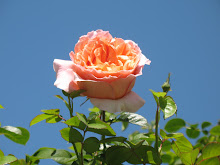
Some of Spring's first roses


I pruned my canes fairly aggressively this winter, in early January, and the first big blooms are starting now, but the rose garden is probably two weeks away from its first big flush of blooms.  Here are some of the nice ones:  The peach bloom is a pretty massive David Austin Abraham Darby.  This has unbelievable scent, the only downfall is that the blooms are not long-lasting and often over-weight their support stem.  The bi-color is Betty Boop, which really grows similar to Iceberg in form.  This plant is in a pretty shady spot in the shadow of a massive climber rose on an arbor, yet it still performs well.  The red bloom is Fame, easily the longest lasting flower of the 25-odd varieties I grow, but absolutely no scent whatsoever.  Fame is also an extremely prolific bloomer with decent stems for cutting.  All of these plants are about ten years old, and I utilize a simple tube irrigation system.

Monday, March 23, 2009

Euphorbia euphoria


This spectacular plant is Euphorbia tirucalli, or pencil bush.  Poinsettias are also a member of the amazingly diverse euphorbia family, though it bears no resemblance to pencil bush whatsoever.  Right now, my pencil bushes are literally glowing with this beautiful red, coral hue.  They normally are dark green.  The Sunset Western Garden Book states pencil bush is best grown in three narrow climate zones - Zones 23, 24 and 13.  23 and 24 are frost-free coastal zones, while 13 is low desert, including Palm Springs.  This winter had brought a few very cold nights here in zone 23, where even puddles of water completely froze over.  Possibly this cold weather is the cause for this beautiful display of color?

Regardless, pencil bush is practically foolproof to grow, requires little water and propagates easily from clippings.  It achieves a unique and sculptural form up to several feet high.  It also performs well and looks great as a centerpiece specimen for a large pot.